

Towards Co-Optimization of Neural Network Training Components
Dr Low Kian Hsiang, Associate Professor, School of Computing
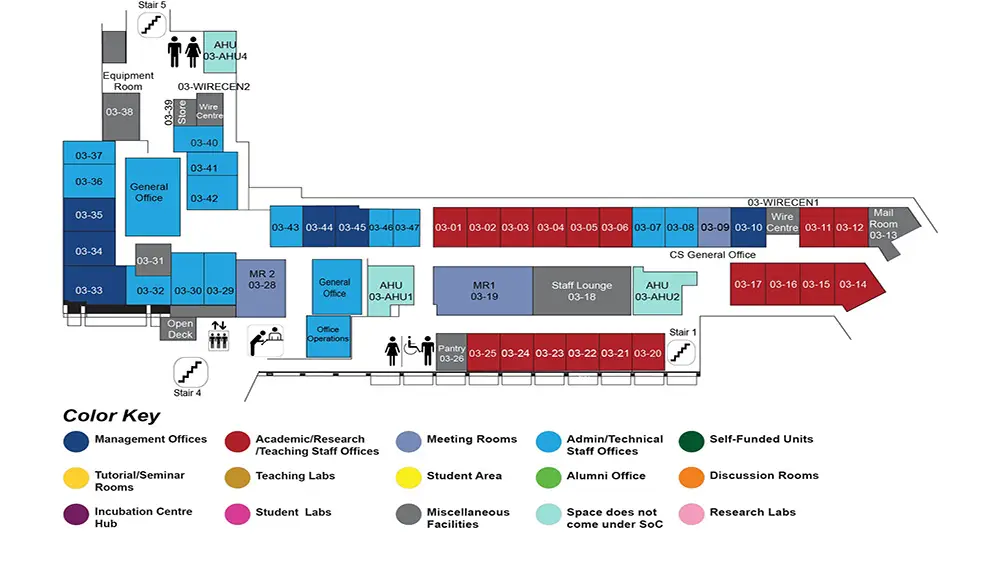
COM1 Level 3
MR1, COM1-03-19
Abstract:
Training a neural network (NN) involves making design choices about several training components. The practitioner would need to specify the NN architecture that they think best fits the problem and collate training data on which the NN will be trained. Additionally, practitioners may incorporate prior knowledge, which provides additional guidance for NN training. Finally, we require compute on some hardware to perform the NN training process. While existing works in the literature attempt to optimize these four training components independently, they have not considered how they depend on one another and how they can be co-optimized.
In this thesis, we discuss the importance of co-optimizing these training components and how to do so. In the first part, we consider the co-optimization of data and model under a unified framework. We introduce the concept of initialization robustness, which quantifies how robust the training process is to random NN weight initializations. We then devise a scoring criterion and an optimization method that enable the active selection of training data and the NN architecture, such that the trained NN is initialization-robust and achieves good predictive performance in expectation.
In the second part, we consider the co-optimization of training data and application of prior knowledge through the lens of physics-informed neural networks (PINNs) where the prior knowledge is in the form of known partial differential equations (PDEs). Specifically, we discuss how the choice of collocation points encoding the prior knowledge from the PDE will affect the informativeness of different experimental data, and vice versa. We then consider two practical objectives for PINN training, based on reconstructing the PDE solution and recovering some unknown PDE parameter, and propose appropriate criteria for each of these objectives.
In the third part, we consider how to make NN training more compute-efficient in multi-GPU, parallelized scenarios. We discuss how existing methods for optimizing the parallelism configuration (PC) to maximize training throughput are insufficient because they rely solely on an accurate estimate of the actual training throughput or on training trials. Instead, we propose a method that combines existing domain knowledge of parallel NN training with actual throughput measurements, adaptively selected via Bayesian optimization (BO), to find the optimal PC across a wide range of training scenarios.
Finally, inspired by the optimization of PC, we incorporate these ideas to co-optimize the language model (LM) architecture and PC to obtain an LM with optimal performance given the available compute budget. We discuss how using existing knowledge from parallelized NN training and from neural scaling laws, coupled with efficient trialing via BO, can enable us to extrapolate performance trends and automatically identify better PC and LM architectures for various large-scale training scenarios.
The techniques proposed in this thesis offer new perspectives on optimizing various training components and show that their choices are often interrelated and should therefore be co-optimized. Additionally, they often have characteristics which can be exploited by careful designs of the optimization algorithm. These works also serve as a starting point for a more unified method to globally co-optimize the different training components for more resource-efficient NN training, especially in the modern machine learning landscape.