

COMPUTER SCIENCE RESEARCH WEEK JANUARY 2024
Professor Jean Ponce, Ecole Normale Supérieure at PSL
Professor Olya Ohrimenko, University of Melbourne
Professor Natarajan Shankar, Distinguished Senior Scientist and SRI Fellow, SRI Computer Science Laboratory
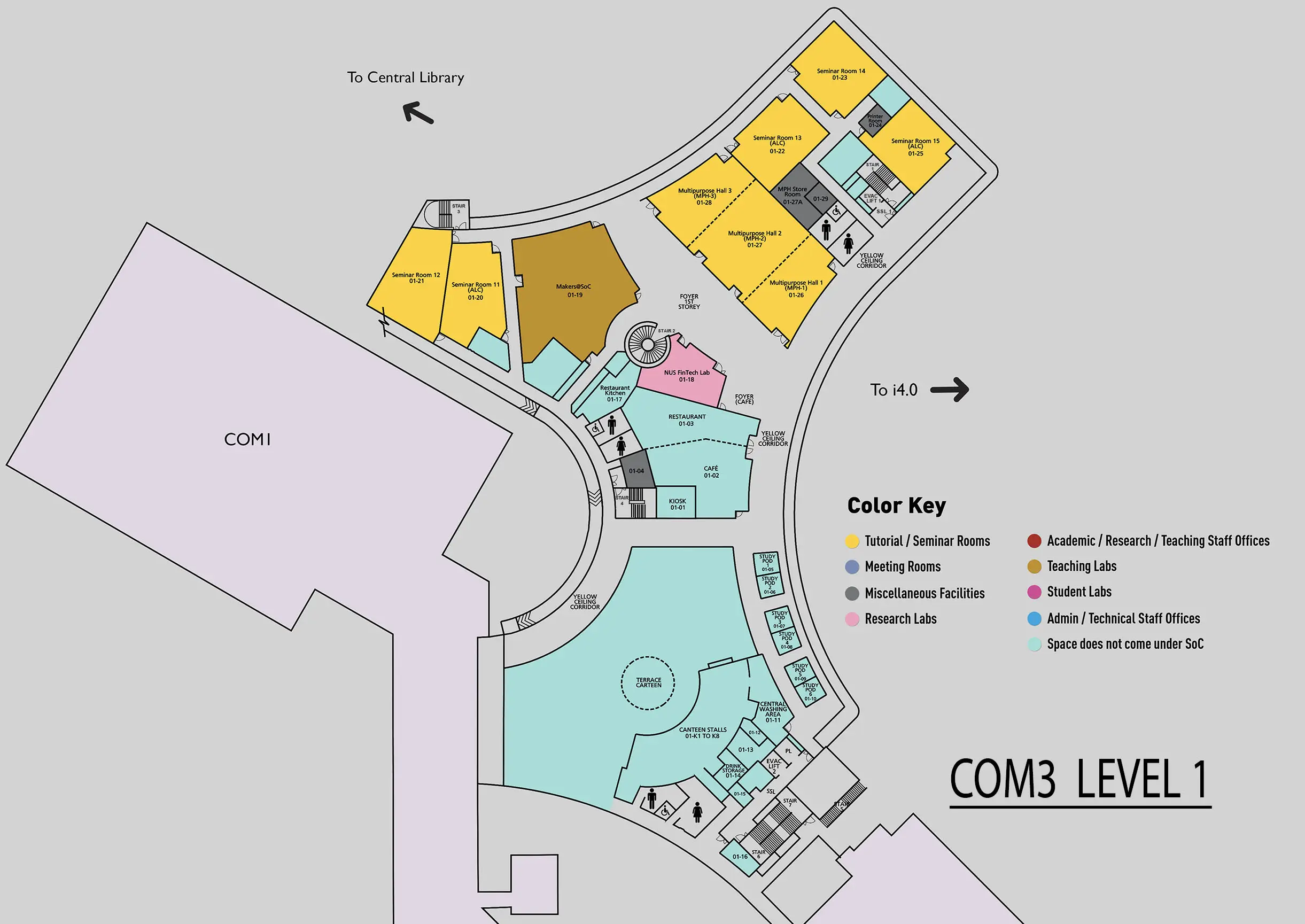
COM3 Level 1
Multipurposed Hall 1, 2 and 3 [COM3 01-26, 01-27 and 01-28]
This is a distinguished talk as part of the NUS Computer Science Research Week 2024 https://researchweek.comp.nus.edu.sg/
10:00 - 11:20 On Watermarking Generative AI in Generative AI Era - Yu-Xiang Wang
Abstract:
In this talk, I will give a tutorial style-talk that covers the motivation, challenges and recent advances associated with the problem of watermarking generative AI. Specifically, I will highlight the urgent need for watermarking AI generated content and then discuss two of our recent work on this problem. For text, I will present a simple watermark that comes with guaranteed quality (nearly indistinguishable from original), correctness (Type I / II errors) and security (against arbitrary edits).
For images, I will talk about how any invisible image watermarks can be certifiably removed using modern generative AI tools, and highlight a few possible ways to get around this attack. References: 1.[ZALW23] https://arxiv.org/abs/2306.17439 2. [ZZWL23] https://arxiv.org/abs/2306.01953
Bio: Yu-Xiang Wang is the Eugene Aas Associate Professor of Computer Science at UCSB. He directs the Statistical Machine Learning lab and co-founded the UCSB Center for Responsible Machine Learning. He is also a Visiting Academic with Amazon Web Services’s AI research lab. Yu-Xiang received his PhD in 2017 from Carnegie Mellon University (CMU), and his BEng and MEng from the National University of Singapore in 2011 and 2013 respectively. Yu-Xiang’s research interests include statistical theory and methodology, differential privacy, reinforcement learning, online learning and deep learning. His work had been supported by an NSF CAREER Award, Amazon ML Research Award, Google Research Scholar Award, Adobe Data Science Research Award and had received paper awards from KDD'15, WSDM'16, AISTATS'19 and COLT'21.
13:00 – 14:20 Beyond the computer vision comfort zone - Jean Ponce
Abstract:
Spectacular progress has been achieved in computer vision in the past dozen years, in large part thanks to black-box deep learning models trained in a supervised manner on manually annotated data, sometimes unrelated to any real task. I propose instead to give back to accurate physical models of image formation their rightful place next to machine learning in the overall processing and interpretation pipeline, and will discuss applications to two real engineering and scientific tasks, namely super-resolution and high-dynamic range imaging from photographic bursts acquired by handheld smartphones, and exoplanet detection and characterization in direct imaging at high contrast. In this context, realistic synthetic data are easy to generate without any manual intervention, but real ground truth is typically missing. I will also discuss new approaches to video prediction where real data is readily available, and training can be achieved in a self-supervised manner using temporal consistency. I will conclude by discussing potential real applications to this admittedly somewhat artificial problem.
Bio: Jean Ponce is a Professor at Ecole Normale Supérieure - PSL, where he served as Director of the Computer Science Department from 2011 to 2017 and a Global Distinguished Professor at the Courant Institute of Mathematical Sciences and the Center for Data Science at New York University. He is also the co-founder and CEO of Enhance Lab, a startup that commercializes software for joint demosaicing, denoising, super-resolution and HDR imaging from raw photo bursts. Before joining ENS and NYU, Jean Ponce held positions at Inria, MIT, Stanford, and the University of Illinois at Urbana-Champaign, where he was a Full Professor until 2005. Jean Ponce is an IEEE and an ELLIS Fellow and was a Sr. member of the Institut Universitaire de France. He has served as Program and/or General Chair of all three top international Computer Vision Conferences, CVPR (1997 and 2000), ECCV (2008) and ICCV (2023), and as Sr. Editor-in-Chief of the International Journal of Computer Vision. He currently serves as Scientific Director of the PRAIRIE Interdisciplinary AI Research Institute in Paris. Jean Ponce is the recipient of two US patents, an ERC advanced grant, the 2016 and 2020 IEEE CVPR Longuet-Higgins prizes, and the 2019 ICMLtest-of-time award. He is the author of "Computer Vision: A Modern Approach", a textbook translated in Chinese, Japanese, and Russian.
15:00 - 16:20 Privacy and Security Challenges in Machine Learning - Olya Ohrimenko
Abstract:
Machine learning on personal and sensitive data raises privacy concerns and creates potential for inadvertent information leakage (e.g., extraction of one’s text messages or images from generative models). However, incorporating analysis of such data in decision making can benefit individuals and society at large (e.g., in healthcare and transportation). In order to strike a balance between these two conflicting objectives, one has to ensure that data analysis with strong confidentiality guarantees is deployed and securely implemented.
My talk will discuss challenges and opportunities in achieving this goal. I will first describe attacks against not only machine learning algorithms but also naïve implementations of algorithms with rigorous theoretical guarantees such as differential privacy. I will then discuss approaches to mitigate some of these attack vectors, including property-preserving data analysis. To this end, I will give an overview of our work on ensuring confidentiality of dataset properties that goes beyond traditional record-level privacy (e.g., focusing on protection of subpopulation information as compared to that of a single person).
Bio: Olya Ohrimenko is an Associate Professor at The University of Melbourne which she joined in 2020. Prior to that she was a Principal Researcher at Microsoft Research in Cambridge, UK, where she started as a Postdoctoral Researcher in 2014. Her research interests include privacy and integrity of machine learning algorithms, data analysis tools and cloud computing, including topics such as differential privacy, dataset confidentiality, verifiable and data-oblivious computation, trusted execution environments, side-channel attacks and mitigations. Recently Olya has worked with the Australian Bureau of Statistics, National Bank Australia and Microsoft. She has received solo and joint research grants from Facebook and Oracle and is currently a PI on an AUSMURI grant. See https://oohrimenko.github.io for more information.
16:30 – 17:50 Designing Software for Certification - Natarajan Shankar
Abstract:
The versatility and flexibility of software makes it an indispensable tool for building critical systems, but its inherent complexity opens up vulnerabilities that can compromise safety and security. Software failures due to design flaws and bugs can be costly. These flaws are extremely expensive to fix once the software has been deployed. Safety-critical software systems need assurance that the software operates safely and securely prior to deployment. Such systems must therefore be designed with rigorous claims supported by reliable, reproducible, and maintainable evidence. We motivate the need for constructing software hand-in-hand with an assurance argument backing the critical safety and security claims. We describe some technologies that we have been developing to assist with design for certification. Specifically, we outline the ``efficient argument'' approach to system design, the use of formal architectures as a foundation for efficient compositional arguments, ontic type analysis linking the requirements ontology to code-level representations, automatic code generation from high-level specifications, and the Evidential Tool Bus (ETB) architecture for integrating evidence-generating tools within a design workflow for building and maintaining assurance arguments. The talk presents joint work with members of the DesCert (Design for Certification) project team.
Bio: Dr. Natarajan Shankar is a Distinguished Senior Scientist and SRI Fellow at the SRI Computer Science Laboratory. He received a B.Tech. degree in Electrical Engineering from the Indian Institute of Technology, Madras, and Ph.D. in Computer Science from the University of Texas at Austin. He is the author of the book, "Metamathematics, Machines, and Godel's Proof" (Cambridge University Press) and the co-developer of a number of technologies including the PVS interactive proof assistant, the SAL model checker, and the Yices SMT solver. He is a co-recipient of the 2012 CAV Award and the recipient of the 2022 Herbrand Award.